I've been reading "The Last Train to Zona Verde," a new Paul Theroux book about a former Peace Corps Volunteer traveling through southern/western Africa. It's a little condescending and his writing style is a bit weird sometimes, but he brings up some good points.
One of the ones which I found particularly salient has to do with foreign aid. Theroux discusses it in terms of monetary aid, but I think this issue can really be discussed more broadly – including aid in the form of money, personnel, advice, etc.
Africa as a whole is pretty much overwhelmed with foreign aid. Basically any organization of people with some kind of goodwill see that there is a lot of need in Africa, and think that their contributions can probably fix some of these things. It's a fair point, and I really think it's great that we have these people who want to contribute to those whoa re less fortunate.
But Theroux also brings up the counterargument, which is one we have heard from Peace Corps time and again (when it comes to money). If you give people everything, they don't learn how to do it themselves. Giving a man a fish, and such. You can imagine the argument. If we (and I mean "we" in the broadest sense – anyone from a somewhat more developed area who is trying to do something good) provide EVERYTHING in terms of aid, people and organizations here aren't self-sufficient. If we provide the expertise to set up businesses, governments, and other organizations. nobody knows how to go about it the next time around. If we give the money to build the schools and computer labs, there is less ownership, and the people truly value these things less.
Here's my question, though. To what extent does this argument reach? I can imagine an extension that goes, "If we provide the teachers for the schools, the locals don't learn how to teach, and the kids don't have local role models. They need these role models – teachers and otherwise – to see that they can really be successful in life." I think this argument has legitimacy, personally. However, it's also hard to say I don't have a legitimate role here. Peace Corps tries hard to make sure our efforts are "sustainable," which means I'm not just a teacher, but I should also be training the other teachers n skills so that they can continue on their own. I shouldn't be creating new programmes unless there is a local counterpart who will continue it when I leave.
The role of volunteers can definitely be debated. But I think that the question is more interesting when you dig down farther, because volunteers truly can make only a limited difference. What about foreign aid in the broader sense?
My village has gotten a TON of things from various investors and sponsors and … aid. I've thought about it broadly, but some of the local implications are still coming out. Here's an example: we are starting to plan the 50th anniversary celebration for my school, which will happen in about a year. In conjunction with this, we are discussing the future of the school. What is our vision, what do we need, etc? It's all really exciting. But when we discuss this "development" of the school, it usually comes down to money. Don't worry, they tell us. We can write grants and proposals and get the money from somewhere.
It's the same on a smaller scale. There isn't financial planning. When the kids go to sports competitions, the teachers end up contributing all of the money because these expenses aren't assumed by the institution. When the school runs out of paper, the principal has to buy it out of her paycheck. When the staff wants a microwave in the staff room, we all buy it. These are small things, but in my opinion, they are examples of how the school hasn't yet learned to PLAN. Income should be greater than expenses, but it hasn't happened yet.
Many of these things are cultural, sure. Namibia is a young country, development is still occurring, people are still getting used to the modern world of capitalism.
But still, you have to wonder. Would "development" happen faster or slower if we just left the village to itself? Is the aid a necessary component that is required to get things started, or are we simply delaying the process by which people and institutions will become self-sufficient?
Thursday, October 24, 2013

Thursday, October 3, 2013
"African Black Magic"
A few days ago, my kids started getting possessed by evil
spirits.
I know this sounds absurd… I don’t technically believe in
witches, witchcraft or “African Black Magic” as they have been calling it. That
didn’t stop the last few days from freaking the hell out of me!
Sunday afternoon—my kids say something bad happens every
Sunday at our hostel—two girls collapsed outside of the girls’ block
(dormitory). The sisters started seeing people who they knew but could not
name, screaming, writhing, kicking… Apparently they were possessed by a spell.
Honestly, I wasn’t paying much attention because I thought it was a bunch of
crap and would soon resolve itself.
After a few hours, the girls had indeed recovered and all
was fine at the hostel again. But after dinner, a bunch of other kids “got it.”
I was having our Sunday night family dinner with the volunteers of Tses, and
when some of them went home they told me that there was something big going on
at our eating hall. When I got there, there were about 10 learners lying on the
floor of the hall, screaming and writhing, with a bunch of different elders and
pastors there to help and pray for them.
I, with some of the other teachers and community members,
was there from about 9 until after 3am – sitting with them in the hostel,
holding down kids who were literally trying to get up and run away, restraining
kids who were trying to claw at each other. Most of the children affected were
girls, but there were also a few boys. Apparently this kind of thing is more
common with girls and it is also more common around times of stress, like exam
time. I know there are probably millions of psychological explanations for
everything that happened – but in the end, it is children who are in a great
deal of physical and emotional pain, and regardless of why you think it
happens, it definitely, definitely sucks and is really hard to watch!!
As we were in the hall that night, there were obviously
times of more and less panic. Sometimes the kids were quiet and we sat around
drinking tea, and sometimes they were literally punching and kicking at us! We
had some help from a few other learners, as well as company from those who were
unwilling to go sleep in the blocks that night.
All of the affected learners slept eventually, so I assumed
it was all over. But Monday morning at school, more kids started going wild!
More learners were affected during class and many of the same ones from Sunday
were still having issues. The story goes that there were a few “main” learners
who were being witched by a jealous lady who worked at the hostel, and those
few were the ones who suffered the most and for the longest time.
Monday afternoon, the kids were a mess. They were all scared
of the hostel/blocks/kitchen/food/matrons, and a few were still “possessed.” We
tried to send these ones home to their families ASAP but some of them stay far
away so we sent them to other families in Tses, just to separate them (so they
couldn’t build off of each other anymore). It was so strange to go around
carrying some of my learners who were unconscious, when they are normally very
strong individuals; holding some when they thought they were being choked, etc.
A different way of seeing them, I guess. When I wasn’t busy there, I was going
around to all of the different groups of kids around the hostel, trying to
comfort them as much as I could. Which wasn’t much, but at least some of my
normal visitors came over to visit my house (as well as another group of the
boys who I normally think are very independent but were clearly terrified).
Monday evening, we had what must be called an exorcism. We
had leaders from all the different churches in our hostel’s eating hall along
with community members, all of the hostel matrons, most of the teachers and all
of the kids from the hostel. There were all of the “affected” kids (including a
few new ones) in the back, writhing; and all of the learners in the front,
praying and being prayed for. After what seemed like hours of prayers, the
pastors prayed for every child individually (it took forever!) and sent them
back into the blocks. They were obviously terrified to go alone, but I think it
helped some of them to overcome that fear. At this point, the pastors “got out
the demons” from the affected children. The pastors prayed, touched the
children, yelled at them, spit holy water in their mouths and faces.
Eventually, they got every child to say that they believe in God and Jesus as
our savior. (I’m really glad I understand Afrikaans, since the entire night was
not conducted in English!)
Almost the whole time, there were weird things going on.
Girls rolling around in the back, clawing at each other, kicking. A bunch of
them truly seemed like they were possessed by something strange. One boy wasn’t
allowed to sit with the others (he had been possessed but was now feeling
better) so he sat in back with me. He seemed fine, just weak and scared, and
kept leaning on me or holding my hand or something. It was really cute but also
really sad to see him this way, because he’s normally a really rambunctious
kid!
By today, most of the weird stuff seems to have settled
down. There were a few odd cases throughout the week, and our school is now
really empty because most of the hostel learners have left for their families
for the week. Last night, we had another church service to try to keep the kids
on the right track.
Coming from my culture at home, this stuff all seems weird.
And I know that probably most people reading this will agree that it is all a
load of crap! But guys.. honestly, I don’t know what to say about all of this.
Do I believe in witches? Not really. Being possessed? Not really. But
obviously, something was psychologically and physically affecting my kids, for
a long period of time… and no matter what you think it was, it was really sad
and really hard for the kids. Everyone at my school is exhausted because nobody
has been sleeping (even though I wasn’t personally too scared, I had about 10
kids sleep in my house for a few nights because they were afraid of the blocks…
and getting woken up in the middle of the night because they were scared).
Whatever is going on—even if it is some kind of mass hysteria (or “exam-phobia”
as the regional education director just called it), it doesn’t matter much to
me. The effect is not good either way!
Tuesday, September 24, 2013
The One-Year Mark
Well, Peace Corps Namibia Group 36 has officially been at
site for over a year! I thought we’d never make it.


I can say that it’s been an adventure. I’ve done many new
things (eaten donkey, gone to a wedding, led a youth group…taught a class) but
in many ways, it’s not so different from home. I’ve built up my family and
friends, and I definitely feel like I belong to my community here.
I had a crazy moment last week, though: Thursday night was
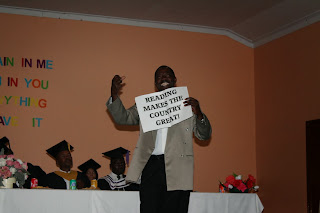
our annual academic achievement awards ceremony. It was the first event I was
here for last year, too. In this evening, we award learners with certificates
for outstanding academic achievements, improvements, and other things (sports,
behaviour, commitment). I remember last year being horribly bored watching the
ceremony, and also feeling bad for not being able to help control the kids from
the audience (where I was standing to take photos).

Our pastor giving the Keynote Address
This year was different. The 3 hour ceremony honestly felt
like nothing. I felt like a proud parent, smiling all the time and mouthing
directions and taking billions of photos of my kids. (Sorry Mom for rolling my
eyes when you “played the piano” with me in my performances and stuff…)

Some of our top academic achievers
More importantly, I feel more successful as a teacher now.
To start with, I was actually able to help keep the kids in the audience under
control when they needed to be. But further – and this is my crowning victory
of the last month or so – I have discovered that I am one of the teachers now.

The only awards I, personally, handed out - to the "Sportsmen" and "sportswomen" who are good leaders, athletes, and teammates.
I helped choose the new prefects, I helped choose learners
for the awards, I helped make the awards. And my input was taken on different
issues. I have been trying pretty hard to follow Peace Corp’s policy on only
intervening when your help is asked for, but I felt like there was a glaring
problem with our Awards Ceremony programme. You see, in the 49 years of my
school’s history, only Head Boys have given a speech at it.
But we have a Head Boy and a Head Girl. And let me just tell
you, the Head Girl this year is way more competent, and a much better speaker,
than the Head Boy. So for the first time since I’ve been working here, I
straight-up argued with my colleagues for hours until they let me add a Head
Girl speech to the agenda.

Our new Head Girl for the 2014 school year giving her speech!
I know one speech won’t change gender relations; it’s not
even a drop in the bucket. But at least we’re trying, right? There is so much
male superiority happening in this place, and that extends to the learners.
Hopefully if we can continue to make changes, even small changes like this one,
to the way we interact at school, we will be able to help some of these girls
grow up to be self-confident and capable individuals!
Thursday, September 12, 2013
Our Role
As Peace Corps Volunteers, we have three specific goals set
forth by the Peace Corps. These are, vaguely:
to improve Namibians’ understanding of Americans,
to improve Americans’ understanding of Namibians,
to assist with development in Namibia in whatever way we can.
As a teaching volunteer, I have another set of goals. These
include things like improving learners’ marks, improving teachers’ capacities
for teaching effectively, improving management at the school and improving
English and critical thinking skills among both learners and teachers. There
are more, but you get the idea.
So, teaching volunteers are placed at schools where there is
perceived to be a need. Schools where learners consistently underperform. The
thought is that at these schools, learners probably are not getting the support
they deserve from teaching staff, and teaching staff are probably not doing
their jobs as far as showing up to school every day, teaching effectively,
communicating ideas in English. It’s our job as volunteers to come in and do
whatever we can to improve the situation, set a good example as a teacher, etc.
But what do I do when these common problems are not the
problems faced by my school? It’s something that I’ve been struggling with, and
I would absolutely love advice from anyone reading this!!!
Many other volunteers complain regularly about teachers who
miss weeks of school at a time, or teachers who sit and do nothing rather than
teaching at the front of the classroom. Teachers who don’t speak English well and
therefore are not well equipped to help the learners pass their exams. Here’s
the thing though—my community doesn’t suffer from these problems. My teachers,
in fact, are a pretty amazing set of individuals. They care a TON about the
learners, they come to school every day, they TEACH in school every day, and
their English is actually very good.
Yet, I had a 15% pass rate on my recent end-of-term exams,
among my grade 8 and 9 learners. These learners attend school every day, and
most of them have at least 2 hours of mandatory study time every day. We taught
every day during the term and reviewed before the exam. The struggle at our
school right now is: why and how is teaching occurring, but learning is not
happening?
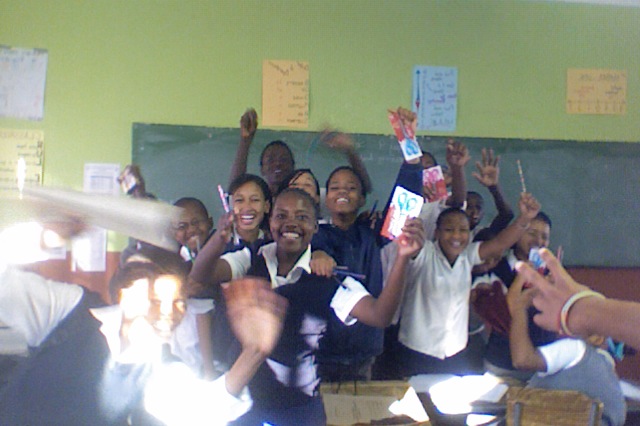
Now, I know I’m a teaching volunteer, so my primary position
is in the classroom. But if the reason I was sent here was to improve the pass
rate of my learners, we need to figure this out. From talking to teachers,
learners, community leaders, and church leaders, the best I can figure out: it’s
a cultural problem, not a school problem. The culture in my region is not a
culture that values education highly. The Nama people were herders, suffered
under the German genocide in the early 20th century, and after that
faced apartheid. Most of the adults haven’t completed formal education past
grade 5 or grade 8, and many of them honestly don’t see the need, since they
subsistence farm for a living. Many kids don’t have frequent parental
supervision, and parents definitely aren’t checking if they have finished their
homework or if they are passing their classes. Many of them aren’t even
checking if their children have eaten 3 meals in a day.
We recently hosted a “parent meeting” – we have one at the
beginning of every term in order to try to keep a supportive school
environment. 14 parents attended, and I have about 210 learners. This is the
kind of support we are commonly receiving from the community.
My philosophy so far has been that probably I can make more
of a difference by working with the community rather than spending all of my time
in the classroom. Working with the young people here to stay busy and motivated
(and be good role models for the kids and good future parents), working with
parents, working with the community leaders. But I don’t know. How do you work
within this kind of community and expect to make any kind of difference?
Sunday, September 8, 2013
August in photos
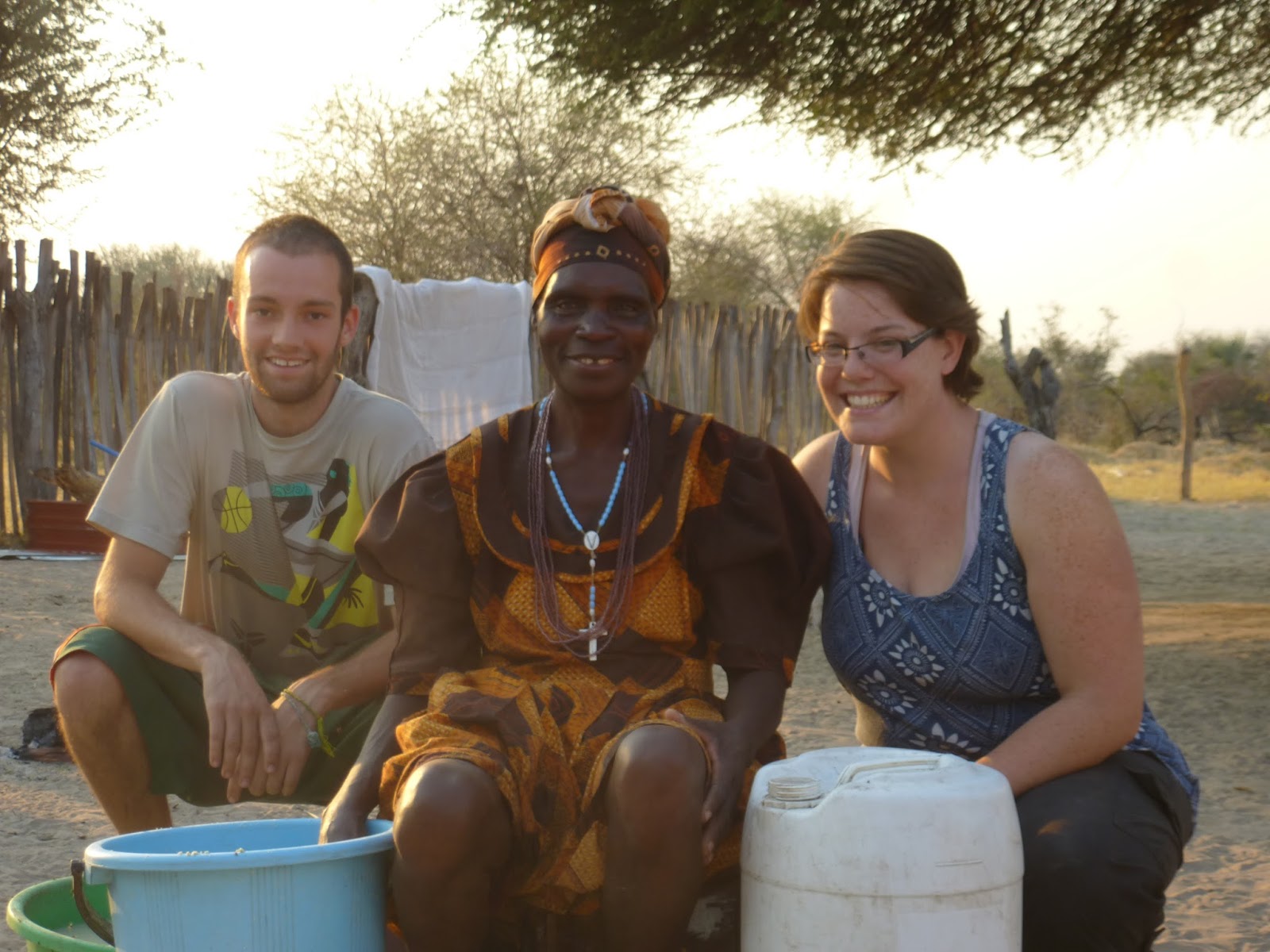
Mom came to visit, I saw some places in the north. Enjoy!
Etosha national park:



Real family and host family meet up in Okahandja:

Steph's village outside of Rundu:


Friday, September 6, 2013
Grandpa, this one’s for you.
I don’t know much about farming, but I am always a little
interested in it because of the family farm! Not that my kids believe me when I
say there are farms in America, but still.
Namibia’s currently facing a huge, horrible drought. Last
year, there was pretty much no rain in my village and everywhere in the country
experienced significantly less rainfall than normal.
Over our August holiday, I got the chance to see some of the
north of Namibia, where things are generally greener and farming is a much
bigger deal. They can also actually raise cattle because there’s enough water
and food. But all I heard from anyone in the north was how dry it is right now,
and how worried everyone is about having enough food and livestock to make it
through the year. If the rainy season is not good this year, it will be a big
problem. Luckily, at least in towns and in some villages, the government is
providing drought relief in the form of supplementary food—but it isn’t enough
for most families, and we don’t know how long it will continue.
When I was coming home, I got a lift with a farmer from the
middle part of the country. He had a few more details for me. He said that last
year he had about 150 head of cattle. Cattle are better to raise if you can
afford it, because they are harder to steal and big enough that jackals cannot
pick them off of the herd in the night. Well, this farmer had about 10mm of
rain in 2012 instead of the ~200 he needs to keep his cattle on his land. He
sold a bunch, so he is down to 76 with an additional 36 calves. He is waiting
for the calves to make 200kg so he can sell them too, because there just isn’t
enough food and water.
The problem with this was that farmers all over Namibia had
to sell livestock early this year, so prices were horrible and most of them
lost money. Now they are trying to make it up in a poor economy (not that I
know much about economics, but the dollar keeps gaining on the Nam dollar) and
in a climate that is not helping them out!
In a country where farming, and subsistence farming at that,
is a primary source of livelihood for much of the population, things like
droughts hit really hard. And since everybody here has accepted climate change
and knows it will continue to worsen, you have to wonder how they will manage
to stay afloat?
sorry it's been so long since the last posts, guys! More to come soon about my recent holiday travels and our school here =)
Tuesday, July 16, 2013
Is she a Nama lady??
Guys, I’ve made it.
I’ve made it hard.
Someone asked last night if I was Nama.
But I digress - the occasion was actually the point of this
blog post.
There was a Nama wedding celebration last night. It was for
the brother of a friend of mine, and Jenita, Lily and I were invited to attend
the celebration.

It was awesome – we got to get dressed up in Nama clothes!
The actual wedding was in Windhoek last week, but this was
the traditional Nama wedding/celebration. When we got to the house where the
wedding was being held, we were invited inside to sit with the elders. It was a
huge honour and we are still not sure why they allowed us!
After a few minutes, the actual ceremony began. Some of the
elders began to dance outside of the traditional hut, and the groom escorted
the bride out of the hut where they must stay (per tradition). Her head and
face were covered with a towel, so he had to lead her. They danced the
traditional dance with the elders for awhile (which is really impressive given
that she couldn’t see anything!!)

After the dance, we all went back inside the living room,
where the bride and groom were seated at a table. An elder led a short prayer
and ceremony, and the groom’s sister uncovered the bride’s head.

Each elder was given an opportunity to speak. We couldn’t
understand any of the blessings since they were in the Nama click language, but
we are told they were very beautiful, inspirational and wise. The groom, when
it was finally his turn to speak and thank everybody, was really sweet and
switched to English for a minute. He informed us that the elders had been
blessing the new couple and passing on their knowledge as 2 they could. He also
thanked us for attending and for trying to follow their culture (wearing
traditional dress, etc.).
When the ceremony had concluded, the ladies from the family
served the food they had prepared ahead of time. Then the younger generation
(kids and the young twenty-somethings, us included) escaped outside to dance
for awhile. Eventually, the elders and the new couple prayed again and all the
extras slowly left.

It was such a great honour and experience to be able to
witness such a wedding! Even my friend Elden said he had learned from the
ceremony, because these traditions are not often followed anymore. A great
learning experience all around!

Subscribe to:
Posts (Atom)